Distribution of Labor Absorption in the Inisiatif Lampung Sehat Non-Governmental Organization (NGO) Across Regencies/Cities in Lampung Province, 2025
Article Sidebar
Main Article Content
Abstract
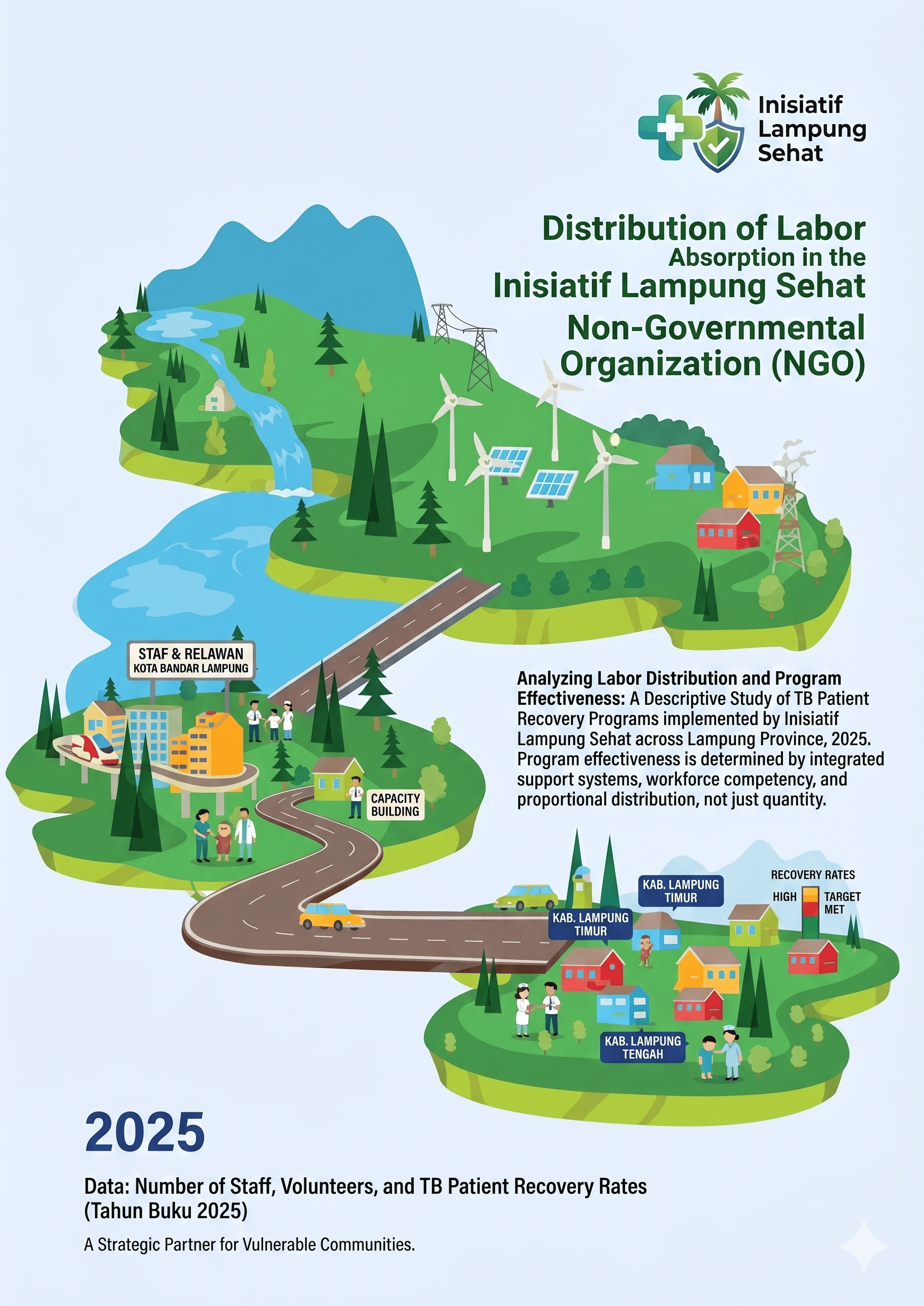
Public health development at the regional level requires the involvement of various stakeholders, including non-governmental organizations (NGOs) as strategic partners of the government in reaching vulnerable communities. This study aims to analyze the distribution of labor absorption and the effectiveness of program output achievements in Tuberculosis (TB) patient recovery programs implemented by the Inisiatif Lampung Sehat in Lampung Province. The study employed a descriptive approach utilizing both primary and secondary data related to the number of staff, volunteers, and TB patient recovery rates in 2025 across several regencies/cities within the intervention areas. The program output achievements demonstrated significant variations among regions, with several areas attaining very high recovery rates, even exceeding the established targets. However, the findings indicate that the number of workers is not always directly proportional to program success. Instead, program effectiveness is influenced by several factors, including the quality of implementation, workforce capacity, as well as social conditions and supporting systems in each region. The study concludes that the effectiveness of TB control programs is determined not only by the quantity of labor but also by proportional workforce distribution, the competency of field personnel, and the strength of integrated support systems. Therefore, a more adaptive and region-based human resource management strategy is required to improve program achievements in an equitable and sustainable manner.
Downloads
Article Details

This work is licensed under a Creative Commons Attribution-ShareAlike 4.0 International License.
References
(GURĂU), C. (2022). Human resource management strategies in organizations.
(GURĂU), M. F. (2022). The importance of ergonomics in human resources management. Bulletin of “Carol I” National Defense University, 10(4), 78–81. https://doi.org/10.53477/2284-9378-21-46
Aboramadan, M. (2018). NGOs management and human resource practices.
Aboramadan, M. (2018). NGOs management: a roadmap to effective practices. Journal of Global Responsibility, 9(4), 372–387. https://doi.org/10.1108/JGR-08-2018-0033
Afzal, A., & Nasir, M. (2023). Public health challenges in developing regions.
Afzal, S., & Nasir, M. (2023). Role of Non-Governmental Organizations as Developmental Partners in Health Care. Annals of King Edward Medical University, 29(1), 1–2. https://doi.org/10.21649/akemu.v29i1.5335
Anbazhagan, S., & Surekha, A. (2016). Role of NGOs in community health development.
Anbazhagan, S., & Surekha, A. (2016). Role of non-governmental organizations in global health. International Journal of Community Medicine and Public Health, 3(1), 17–22. https://doi.org/10.18203/2394-6040.IJCMPH20151544
Annazah, et al. (2022). Informal sector employment in Indonesia.
Arshad, M. (2024). The impact of NGOs on community health systems.
Arshad, M. R. M. (2024). Non-Govermental Organizations: Social mobilization and empowerment for community health promotion. https://doi.org/10.21834/e-bpj.v9isi20.5847
Aruna, M., & Thanasundari, S. (2015). Human resource challenges in NGOs.
Aruna, R., & Thanasundari, S. (2015). Organizational problems of non-governmental organizations (NGOS). 2(1), 58–62. https://doi.org/10.15740/HAS/IJHSECM/2.1/58-62
Asar, F., et al. (2015). Workforce distribution and healthcare outcomes.
Asar, M. E., Varehzardi, R., Vasokolaei, G. R., Haghi, M., & Fazelipor, M. (2015). Regional disparities in the distribution of healthcare workers: evidence from Iran, Chaharmahal and Bakhtiari province. Global Journal of Health Science, 7(2), 374–378. https://doi.org/10.5539/GJHS.V7N2P374
Awadh, M. A. (2024). Enhancing Productivity through the Utilization of a Work-Measuring Methodology. Proceedings of the International Conference on Industrial Engineering and Operations Management. https://doi.org/10.46254/an14.20240606
Azam. (2022). The role of non-profit organizations in sustainable social services and organizational funding. Journal of Non-Profit and Public Sector Studies, 14(2), 115–129.
Campbell, J., et al. (2013). A universal truth: No health without a workforce. The Lancet.
Cantika. (2017). Analisis faktor-faktor yang memengaruhi penyerapan tenaga kerja wanita di sektor informal Jawa Timur. Jurnal Ekonomi Pembangunan, 15(1), 66–78.
Clark, et al. (2024). Community granting, organizational networking, and sustainability of local community programs. International Journal of Community Development, 18(1), 44–61.
Corrêa, C. R. T., Neves, A. C. O., Cardoso, J. M. dos S., Vaz, J. D. B., Silva, P. N. S. da, Branco, S. C. M., Ribeiro, S. B. M. H. A., & Abreu, I. C. (2024). The role of non-governmental organizations in promoting public health and combating inequalities. https://doi.org/10.56238/arev6n3-142
Corrêa, et al. (2024). NGO contributions in public sector collaboration.
Daslan, D., Saafi, L., & Tasnim, T. (2022). Relationship between human resources and planning with minimum coverage of health care services in konawe regency. Indonesian Journal of Health Sciences Research and Development, 3(2), 144–149. https://doi.org/10.36566/ijhsrd/vol3.iss3/103
Daslan, et al. (2022). Human resources in community-based health programs.
Dewi, M., Manochin, M., & Belal, A. (2019). NGO accountability and workforce structure.
Donessouné, et al. (2023). Sustainability of community-based health programs after grant funding support. Global Public Health Review, 11(3), 201–218.
Frenk, J., et al. (2010). Health professionals for a new century. The Lancet.
Gary S. Becker. (1993). Human Capital: A Theoretical and Empirical Analysis with Special Reference to Education (3rd ed.). Chicago: The University of Chicago Press.
Lassa, J. A., Amri, A., Tebe, Y., Towers, B., & Haynes, K. (2023). Exploring NGOs-government collaboration strategies in institutionalising child-centred disaster resilience and climate change adaptation. Progress in Disaster Science. https://doi.org/https://doi.org/10.1016/j.pdisas.2023.100284
Lassa, J., et al. (2023). Community engagement in public health programs.
Lehmann, U., Dieleman, M., & Martineau, T. (2008). Staffing remote rural areas in middle- and low-income countries. Human Resources for Health.
Miles, M. B., Huberman, A. M., & Saldaña, J. (2014). Qualitative Data Analysis.
Moleong, L. J. (2018). Metodologi Penelitian Kualitatif.
Piotrowicz, M., & Cianciara, D. (2013). The role of NGOs in health systems.
Piotrowicz, M., & Cianciara, D. (2013). The role of non-governmental organizations in the social and the health system. Przegla̧d Epidemiologiczny, 67(1), 69–155.
Rifkin, S. B. (2014). Community participation in health: a review.
Ronald W. Shephard. (1970). Theory of Cost and Production Functions. Princeton: Princeton University Press.
Schell, et al. (2023). Organizational capacity, funding stability, and workforce sustainability in non-profit organizations. Journal of Social Sector Management, 9(4), 87–103.
Schütze, H. (2024). NGOs and public health systems.
Schütze, H. (2024). Non-governmental organizations (NGOs). https://doi.org/10.1016/b978-0-323-99967-0.00170-8
Soesanto, E., & Abdurrahman, N. N. (2020). The Role of Volunteers in Improving Services in Elderly Integrated Service Centers. 2(1), 22–26. https://doi.org/10.26714/SEANR.2.1.2020.22-26
Soesanto, T., & Abdurrahman. (2020). Manajemen sumber daya manusia dalam organisasi.
Sugiyono. (2017). Metode Penelitian Kualitatif.
Sugiyono. (2019). Metode Penelitian Kuantitatif, Kualitatif, dan R&D. Bandung: Alfabeta.
Taufiq. (2021). The role of NGOs in promoting social inclusion and equality in urban areas of Dhaka, Bangladesh. Asian Journal of Social Development, 7(2), 55–70.
World Bank. (2020). World Development Report.
World Health Organization. (2016). Global strategy on human resources for health: Workforce 2030.
World Health Organization. (2020). State of the world’s nursing report.
World Health Organization. (2023). Global Tuberculosis Report 2023. Geneva: World Health Organization.