A Survey Of Injury Management In The Askab Pssi U-15 Sumenep Regency Competition Using The Rice Method (Rest, Ice, Compressed, Elevation) At Ahmad Yani Stadium Sumenep In 2024
Keywords:
Football, ASKAB U-15, , Injury, RICE, First AidAbstract
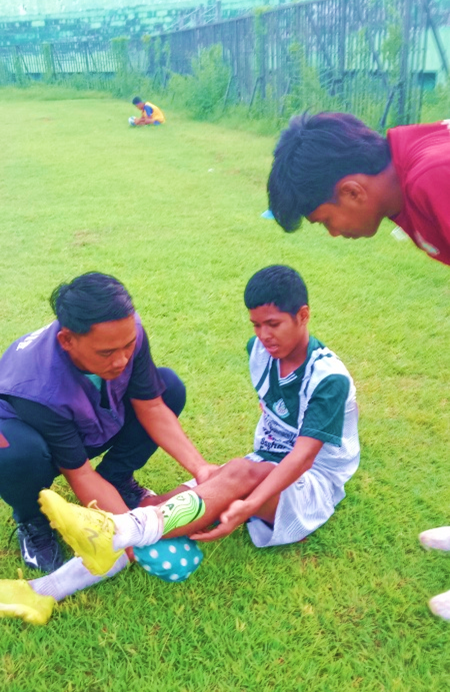
Survey on Injury Management in the U-15 ASKAB PSSI Sumenep County Competition Using the RICE Method (Rest, Ice, compression, Elevation) at Ahmad Yani Stadium, 2024. Siti Subaida This research aimed to determine the effectiveness of applying the RICE (Rest, ce, Compression, Elevation) method in managing injuries during the U-15 ASKAB PSSI Sumenep County Competition at Ahmad Yani Stadium, Sumenep in 2024. A qualitative research method was employed, with data collected through interviews. The research findings indicated that the performance of the team's medical staff during the matches was suboptimal, both theoretically and practically. Respondents did not fully implement the RICE method. They only applied Rest and Ice as first aid for injuries. Compression and Elevation were not performed. This was due to the fact that most injuries were mild and also because the medical team coordinators were only on duty during the match and not after the U-15 match ended. Theoretically, the respondents were also found to be suboptimal. This was because respondents did not have a massage certificate and had never attended any massage training or other formal medical training. Nevertheless, injury management was still carried out using a combination of the RICE method (70%) and physiotherapy (30%), which proved effective in injury recovery. Both the RICE method and physiotherapy were found to have a significant effect on the recovery process in certain field situations and conditions.
Downloads
References
Adserà, A. (2025). Artificial intelligence and fertility: Gender and educational inequalities in family formation. Vienna Yearbook of Population Research, 23(1), 1–10. https://doi.org/10.1553/p-5fff-96k6
Andry, D., Hasan, M., & Weldani, F. (2025). Tren Global dan Prospek Game-Based Learning PJOK : Peningkatan Kompetensi Abad 21 Mendukung SDG 4 , 3 , dan 17 melalui Pendidikan Jasmani. In Internasional Conference on Games Based Learning (Vol. 1, Issue Icgbl, pp. 14–21). https://scholar.google.com/citations?view_op=view_citation&hl=en&user=9BgPsc8AAAAJ&pagesize=100&citation_for_view=9BgPsc8AAAAJ:hMod-77fHWUC
Baillifard, A., Gabella, M., Lavenex, P. B., & Martarelli, C. S. (2025). Effective learning with a personal AI tutor: A case study. Education and Information Technologies, 30(1), 297–312. https://doi.org/10.1007/s10639-024-12888-5
Bauermann, M., Rotthoff, T., Hallmen, T., Kunz, M., André, E., & Schindler, A. K. (2025). Medical students’ perceptions of AI-based feedback and feedforward on communication skills in doctor–patient consultation - an acceptance study in a video-based simulation. Medical Education Online, 30(1). https://doi.org/10.1080/10872981.2025.2592414
Chaaban, Y. (2025). Exploring research ethics through the lens of critical posthumanism in the age of Artificial Intelligence. Teaching in Higher Education, 30(7), 1740–1755. https://doi.org/10.1080/13562517.2025.2465995
Garay Gallastegui, L. M., & Reier Forradellas, R. (2024). FASECO: A Framework for Advanced Support of E-Commerce and digital transformation in SMEs with natural language processing-enhanced analysis. Journal of Open Innovation: Technology, Market, and Complexity, 10(4). https://doi.org/10.1016/j.joitmc.2024.100412
Girón, D. C. A., Yovera, S. E. R. Y., Torres de Salinas, F. de M. G., Soto, F. G. C., & Cadenas, D. I. V. (2025). The relationship between knowledge management and artificial intelligence: A thematic analysis from Scopus. Iberoamerican Journal of Science Measurement and Communication, 5(1). https://doi.org/10.47909/ijsmc.1713
Harsanti, H. R., Sudibjo, N., Riady, S., & Yu, P. (2025). Exploring Indonesian teachers’ intention to use artificial intelligence in schools: the impact of digital leadership, digital readiness, and perceived usefulness. Cogent Social Sciences, 11(1). https://doi.org/10.1080/23311886.2025.2593596
Henman, P. W. F. (n.d.). Robodebt cultures and the administrative state: AI, automation, and the erosion of public trust. Australian Journal of Public Administration YR - 2025, 84(1). https://doi.org/10.1111/1467-8500.12652
Hind Moafak Abduljabbar, Waleed Mohammed Abdullah, Sameer Dawood Salman Bazool, Aseel I. Muhsin, Saad T. Y. Alfalahi, & Volodymyr Temnikov. (2025). AI-Driven Environmental Impact Assessments: Ethical and Legal Considerations. Environment and Social Psychology, 10(12). https://doi.org/10.59429/esp.v10i12.3994
Jacobs, C., Johnson, H., Tan, N., Brownlie, K., Joiner, R., & Thompson, T. (2025). Application of AI Communication Training Tools in Medical Undergraduate Education: Mixed Methods Feasibility Study Within a Primary Care Context. JMIR Medical Education, 11. https://doi.org/10.2196/70766
Lau, K., Fernie, G., & Roshan Fekr, A. (2025). Estimating the slip resistant quality of winter footwear using Artificial Intelligence. Safety Science, 181, 106686. https://doi.org/10.1016/j.ssci.2024.106686
Lizano-Sánchez, F., Idoyaga, I., Orduña, P., Rodríguez-Gil, L., & Arguedas-Matarrita, C. (2025). Teachers’ perspective on the use of artificial intelligence on remote experimentation. Frontiers in Education, 10(1). https://doi.org/10.3389/feduc.2025.1518896
Mas’odi, M., Darmayanti, R., Basri, M. H., Prasetyo, D. A., Weldani, F., Hidayatullah, S. H., & Dhakal, A. (2025). Landscape Kompetensi Calon Guru Pjok Di STKIP PGRI Sumenep Melalui Pelaksanaan Kegiatan Outbound Di Bumi Perkemahan Bedengan Batu. In Center of Education Journal (CEJou) (Vol. 6, Issue 1, pp. 9–20). https://doi.org/10.55757/cejou.v6i1.567
Medina-Gual, L., & Parejo, J. L. (2025). Perceptions and Use of AI in Higher Education Students: Impact on Teaching, Learning, and Ethical Considerations. European Journal of Education, 60(1). https://doi.org/10.1111/ejed.12919
Mohebbi, A. (2025). Enabling learner independence and self-regulation in language education using AI tools: a systematic review. Cogent Education, 12(1). https://doi.org/10.1080/2331186X.2024.2433814
Nuraisyah, W., Rasyid, A., Weldani, F., Prasetyo, D. A., & Firdauz, N. W. R. (2023). Efektivitas Model Pembelajaran Langsung, Kooperatif Tipe TGT Dan Media Audio Visual Terhadap Hasil Keterampilan Tendangan Lurus Pada Mata Kuliah Pencak Silat. In PENJAGA : Pendidikan Jasmani dan Olahraga (Vol. 3, Issue 2, pp. 33–43). https://doi.org/10.55933/pjga.v3i2.514
Prasetyo, D. A., Basri, M. H., Mas’odi, M., Weldani, F., & Hidayatullah, S. H. (2025). Analisis Kebutuhan Pengembangan Model Outbound dalam Mata Kuliah PJOK untuk Meningkatkan Keterampilan Motorik Calon Guru. In Center of Education Journal (CEJou) (Vol. 4, Issue 2, pp. 51–65). https://doi.org/10.55757/cejou.v4i2.484
Sciurti, A., Migliara, G., Siena, L. M., Isonne, C., De Blasiis, M. R., Sinopoli, A., Iera, J., Marzuillo, C., De Vito, C., Villari, P., & Baccolini, V. (2025). Compact large language models for title and abstract screening in systematic reviews: An assessment of feasibility, accuracy, and workload reduction. Research Synthesis Methods, 11(2). https://doi.org/10.1017/rsm.2025.10044
Škare, M., Porada-Rochoń, M., & Veselica Celić, R. (2025). Total factor productivity dynamics and the artificial intelligence paradox: Evidence from long-memory analysis. Journal of International Studies, 18(4), 218. https://doi.org/10.14254/2071-8330.2025/18-4/11
Sukma, I. M., & Chustecki, J. (2025). a Micropolitical Lens on Migration: Comparing Political Correctness in Chatgpt and Deepseek. Studia Socjologiczne, 2025(4), 211–231. https://doi.org/10.24425/sts.2025.157351
Tan, J. S., & Thelen, K. (2025). Cloud Capitalism and the AI Transition. Politics and Society, 53(1). https://doi.org/10.1177/00323292251396395
Veiga, A. da. (2025). Ethical guidelines for the use of generative artificial intelligence and artificial intelligence-assisted tools in scholarly publishing: a thematic analysis. Science Editing, 12(1), 28–34. https://doi.org/10.6087/kcse.352
Wagner, G., Ringeval, M., Raymond, L., & Paré, G. (2025). Digital health competences and AI beliefs as conditions for the practice of evidence-based medicine: a study of prospective physicians in Canada. Medical Education Online, 30(1). https://doi.org/10.1080/10872981.2025.2459910
Weldani, F., & Muhammad, H. N. (2015). Penerapan Terapi Nlp (Neuro Linguistic Programming) Untuk Menurunkan Kecemasan Dalam Melakukan Lompat Kangkang Pada Siswa Kelas X. In Jurnal Pendidikan Olahraga dan Kesehatan: Vol. Volume 03 (Issue 2, pp. 303–307). http://ejournal.unesa.ac.id/index.php/jurnal-pendidikan-jasmani/issue/archive303
Published
Issue
Section
License
Copyright (c) 2026 Journal of Student Physical Education and Sports Science

This work is licensed under a Creative Commons Attribution-ShareAlike 4.0 International License.