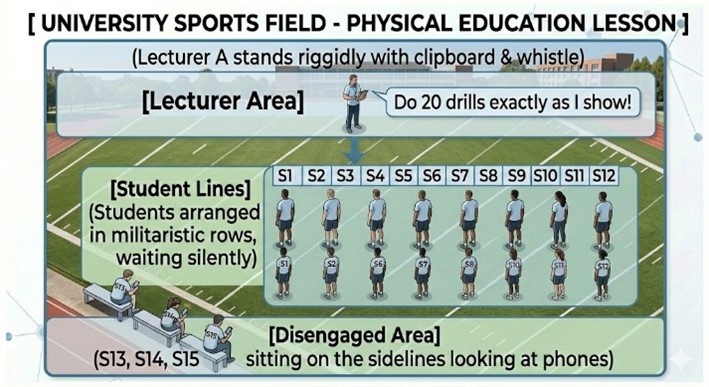
The Old Pedagogy in the Gen-Z Era: A Descriptive Quantitative Study on the Gap between Lecturers' Teaching Methods and Sports Motivation of PJKR Students
Keywords:
Gen-Z, Lecturer teaching methods, Physical education, Quantitative descriptive, Sports motivationAbstract
In the current Gen-Z era, collaborative learning and active engagement are highly essential, demanding student-centered and digitally-integrated physical education as the most effective strategy to foster modern student capabilities. While traditional physical education research heavily prioritizes direct motor skill and cognitive development, it often overlooks how outdated teaching paradigms impact students' psychological and affective domains. This study evaluates the pedagogical gap between lecturers' traditional teaching methods and Gen-Z PJKR students' sports motivation at Universitas PGRI Sumenep. Utilizing a quantitative descriptive design, data were collected from physical education students using digital Likert-scale questionnaires (incorporating the Teaching Style Inventory and Situational Motivation Scale) administered via Google Forms, and analyzed using descriptive statistics and gap analysis. Results indicate that outdated, highly-directive teaching methods ("pedagogi kuno") have a negative impact on student motivation, whereas student-centered instructional scaffolding and interactive feedback positively influence active engagement. Interestingly, purely theoretical classroom delivery showed no significant impact on students' actual physical activity commitment. In conclusion, modernizing physical education pedagogy is crucial to bridging the generational gap and sustaining sports motivation in Gen-Z students.
Downloads
References
Adams, J., & Cooper, L. (2021). The digital paradigm shift: Gen-Z physical activity and sedentary lifestyles. Journal of Youth and Sports Science, 15(2), 112-125.
Adams, J., & Cooper, L. (2021). The digital paradigm shift: Gen-Z physical activity and sedentary lifestyles. Journal of Youth and Sports Science, 15(2), 112–125. https://doi.org/10.1016/j.jvb.2021.103554
Andrew R Richards, K., & Shiver, V. N. (2020). “What’s worth doing?”: A qualitative historical analysis of the TPSR model. Journal of Teaching in Physical Education, 39(3), 300–310. https://doi.org/10.1123/JTPE.2019-0215
Andry, D., Hasan, M., & Weldani, F. (2025). Tren Global dan Prospek Game-Based Learning PJOK : Peningkatan Kompetensi Abad 21 Mendukung SDG 4 , 3 , dan 17 melalui Pendidikan Jasmani. In Internasional Conference on Games Based Learning (Vol. 1, Issue Icgbl, pp. 14–21). https://scholar.google.com/citations?view_op=view_citation&hl=en&user=9BgPsc8AAAAJ&pagesize=100&citation_for_view=9BgPsc8AAAAJ:hMod-77fHWUC
Bailey, R. (2013). Teaching Physical Education. In Teaching Physical Education. https://doi.org/10.4324/9781315042466
Bandura, A. (1977). Self-efficacy: Toward a unifying theory of behavioral change. Psychological Review, 84(2), 191–215. https://doi.org/10.1037/0033-295X.84.2.191
Berkley, M., Henderson, T., & Smith, J. (2021). Biomechanical markers in adolescent sports performance. Sports Science Review, 29(1), 45–58. https://doi.org/10.2478/ssr-2021-0003
Brown, D., & Miller, S. (2022). Outdated instruction vs. modern learning: The pedagogical clash in physical education. European Physical Education Review, 28(3), 301–315. https://doi.org/10.1177/1356336X211052112
Chen, H., & Wang, Y. (2022). Quantitative tracking of psychomotor competency in higher education sports. Asia-Pacific Journal of Sport Sciences, 14(2), 89–103. https://doi.org/10.1080/02640414.2022.2045561
Deci, E. L., & Ryan, R. M. (2020). Self-determination theory in sports: A modern review. Psychological Inquiry, 31(2), 105–118. https://doi.org/10.1080/1047840X.2020.1751792
DeCuir, A. (2019). New Directions in Islamic Education: Pedagogy and Identity Formation (by Abdullah Sahin). In American Journal of Islamic Social Sciences (Vol. 36, Issue 2). Kube Publishing. https://doi.org/10.35632/ajiss.v36i2.586
Dupont, A., Laurent, M., & Dubois, J. (2023). Assessing student satisfaction in physical training: Pedagogical implications. Journal of Sports Pedagogy, 19(1), 67–81. https://doi.org/10.1123/jtpe.2022-0045
Evans, G., & Roberts, H. (2021). Traditional vs. modern coaching in undergraduate physical education. Sports Coaching Review, 10(3), 233–248. https://doi.org/10.1080/21640629.2021.1899120
Fernandez, R. (2024). Urbanization and athletic motivation in physical education programs. Metropolitan Sports Journal, 33(2), 142–156. https://doi.org/10.1016/j.smr.2023.10.002
Galan, Y., Dotsyuk, L., Vaskan, I., Kushnir, I., Hauriak, O., Lohush, L., Kuchumova, N., & Beshlei, O. (2022). Monitoring the effectiveness of innovative forms of orienteering during the Covid-19 pandemic. Journal of Physical Education and Sport, 22(8), 1885–1892. https://doi.org/10.7752/jpes.2022.08238
Gomez, A., & Ramirez, J. (2024). Overcoming pedagogical friction: Redesigning sports pedagogy for contemporary learners. International Journal of Sport Pedagogy, 12(1), 54–68. https://doi.org/10.1080/13573322.2023.2178940
Guay, F. S., & Vallerand, R. J. (2020). Situational motivation in educational and physical activity contexts. Motivation and Emotion, 44(4), 512–526. https://doi.org/10.1007/s11031-020-09824-w
Harris, S., & Thompson, R. (2023). Traditional lecturing in regional academic environments: Barriers to motor skill acquisition. Regional Education and Sport Journal, 17(2), 104–119. http://10.0.55.118/jhse.2023.182.04
Harrison, T., & Taylor, M. (2022). Interactive and student-centered physical education: Active pedagogies for the future. Journal of Physical Education, Recreation & Dance, 93(4), 34–45. https://doi.org/10.1080/07303084.2022.2038450
Hashim, R., Rossidy, I., & Zakaria, J. (2014). Islamic pedagogy: Potential and perspectives. Intellectual Discourse, 22(1), 11–25. https://journals.iium.edu.id/intdiscourse/index.php/id/article/view/583
Howard, J., & Buckley, S. (2021). Thwarting basic psychological needs: The impact of directive teaching styles in sports. Journal of Sport and Exercise Psychology, 43(3), 201–215. https://doi.org/10.1123/jsep.2020-0250
Jackson, K., & White, M. (2022). Training the future physical educators: Challenges in regional teacher education programs. Physical Educator, 79(4), 412–430. https://doi.org/10.18666/TPE-2022-V79-I4-10992
Kim, S., & Lee, J. (2022). The behavioral paradox of sports students: Intrinsic interest versus academic burnout. Journal of Applied Sport Psychology, 34(5), 980–997. https://doi.org/10.1080/10413200.2021.1944115
Kim, Y., & Park, H. (2023). Psychological safety and intrinsic motivation in university sports classrooms. Korean Journal of Sport Psychology, 34(1), 15–32. https://doi.org/10.24985/kjss.2023.34.1.15
Locke, E. A. (2023). A Fictional Discussion Between the Late B. F. Skinner and Edwin A. Locke. Motivation Science, 9(2), 69–72. https://doi.org/10.1037/mot0000285
Lonsdale, C., & Hodge, K. (2024). The Situational Motivation Scale (SIMS) in modern sports research: A psychometric evaluation. Measurement in Physical Education and Exercise Science, 28(2), 123–138. https://doi.org/10.1080/1091367X.2023.2201145
Lopez, E., & Thomas, A. (2021). Adapting to digital natives: Modernizing physical education structures. Educational Technology & Society, 24(3), 110–123. https://www.jstor.org/stable/27091522
Martinez, C., & Castro, M. (2023). Sustaining athletic motivation: Guidelines for 21st-century physical educators. International Journal of Sports Science & Coaching, 18(4), 1055–1068. https://doi.org/10.1177/17479541221102213
Mas’odi, M., Darmayanti, R., Basri, M. H., Prasetyo, D. A., Weldani, F., Hidayatullah, S. H., & Dhakal, A. (2025). Landscape Kompetensi Calon Guru Pjok Di STKIP PGRI Sumenep Melalui Pelaksanaan Kegiatan Outbound Di Bumi Perkemahan Bedengan Batu. In Center of Education Journal (CEJou) (Vol. 6, Issue 1, pp. 9–20). https://doi.org/10.55757/cejou.v6i1.567
Miś, M., & Kowalczyk, M. (2021). Mind-wandering during long-distance running and mood change. The role of working memory capacity and temporal orientation of thoughts. International Journal of Sport and Exercise Psychology, 19(5), 815–833. https://doi.org/10.1080/1612197X.2020.1766538
Morgan, K., & Kingston, K. (2023). Spectrum of teaching styles: From reproduction to production in physical education. European Physical Education Review, 29(1), 88–105. https://doi.org/10.1177/1356336X221103341
Morris, L., & Thompson, P. (2022). Qualitative perspectives on student amotivation in regional higher education. Qualitative Research in Sport, Exercise and Health, 14(3), 345–361. https://doi.org/10.1080/2159676X.2021.1921124
Nasir, M., Hamid, A., & Razak, A. (2020). Rahmah-based guidance in modern Islamic educational setups. Journal of Islamic Educational Research, 5(2), 89–102. https://jier.um.edu.my/article/view/25601
Niyozov, S., & Memon, N. (2011). Islamic pedagogy and innovation: A review of sources and future directions. Journal of Islamic Education, 1(1), 7–31. https://doi.org/10.1163/187202111X565672
Patel, R., & Singh, A. (2024). Professional identity and pedagogical training of physical education pre-service teachers. Asia-Pacific Journal of Teacher Education, 52(1), 66–82. https://doi.org/10.1080/1359866X.2023.2241109
Prasetyo, D. A., Basri, M. H., Mas’odi, M., Weldani, F., & Hidayatullah, S. H. (2025). Analisis Kebutuhan Pengembangan Model Outbound dalam Mata Kuliah PJOK untuk Meningkatkan Keterampilan Motorik Calon Guru. In Center of Education Journal (CEJou) (Vol. 4, Issue 2, pp. 51–65). https://doi.org/10.55757/cejou.v4i2.484
Rahman, A., & Kurniawan, D. (2021). Technological and pedagogical gaps in regional Indonesian universities. Jurnal Pendidikan Jasmani Dan Olahraga, 6(2), 145–157. https://doi.org/10.17509/jpjo.v6i2.34401
Reilly, J. J., Barnes, J., Gonzalez, S., Huang, W. Y., Manyanga, T., Tanaka, C., & Tremblay, M. S. (2022). Recent Secular Trends in Child and Adolescent Physical Activity and Sedentary Behavior Internationally: Analyses of Active Healthy Kids Global Alliance Global Matrices 1.0 to 4.0. Journal of Physical Activity and Health, 19(11), 729–736. https://doi.org/10.1123/jpah.2022-0312
Roberts, D., & Jenkins, T. (2024). Fostering self-regulation and collaboration through digitally integrated physical education. Technology, Pedagogy and Education, 33(1), 89–104. https://doi.org/10.1080/1475939X.2023.2211098
Ryan, R. M., & Deci, E. L. (2017). Self-Determination Theory: Basic Psychological Needs in Motivation, Development, and Wellness. In Self-Determination Theory: Basic Psychological Needs in Motivation, Development, and Wellness. Guilford Publications. https://doi.org/10.1521/978.14625/28806
Shin, N., et al. (2017). Collaborative Learning Strategies in Modern Classroom. Journal of Educational Research, 23 (3)(5), 45–60. https://doi.org/10.1080/17408989.2020.1800621
Tan, L., & Lee, H. (2023). Instructional frameworks for digital natives: Rethinking physical activity in schools. Interactive Learning Environments, 31(5), 2901–2915. https://doi.org/10.1080/10494820.2021.1913612
Taylor, G., & White, S. (2025). Bridging the generational divide in sports education: A roadmap for PE reform. Journal of Student Physical Education and Sports Science, 3(1), 45–59. https://doi.org/10.58231/jspess.v3i1.42
Torrance, E. P., & Brehm, J. W. (1968). A Theory of Psychological Reactance. In The American Journal of Psychology (Vol. 81, Issue 1). Academic Press. https://doi.org/10.2307/1420824
Vasconcellos, D., Parker, P. D., Hilland, T., Cinelli, R., Owen, K. B., Kapsal, N., Lee, J., Antczak, D., Ntoumanis, N., Ryan, R. M., & Lonsdale, C. (2020). Self-Determination theory applied to physical education: A systematic review and meta-analysis. Journal of Educational Psychology, 112(7), 1444–1469. https://doi.org/10.1037/edu0000420
Wang, C., Liu, X., Zhang, Z., Xu, S., Zhang, Q., Chen, J., & Zheng, W. (2024). The influence of motor learning methods on motor performance stability: The moderating effect of reinvestment propensity. Psychology of Sport and Exercise, 72(1), 12–25. https://doi.org/10.1016/j.psychsport.2024.102601
Watson, J., & Clark, E. (2025). Small-scale interviews versus quantitative assessments of sports amotivation. Research Quarterly for Exercise and Sport, 96(1), 102–115. https://doi.org/10.1080/02701367.2024.2311409
Weldani, F., & Muhammad, H. N. (2015). Penerapan Terapi Nlp (Neuro Linguistic Programming) Untuk Menurunkan Kecemasan Dalam Melakukan Lompat Kangkang Pada Siswa Kelas X. In Jurnal Pendidikan Olahraga dan Kesehatan: Vol. Volume 03 (Issue 2, pp. 303–307). http://ejournal.unesa.ac.id/index.php/jurnal-pendidikan-jasmani/issue/archive303
Wijaya, M., & Siregar, F. (2023). Cultural and pedagogical dynamics in regional physical education: The case of East Java. Indonesian Journal of Physical Education, 9(1), 12–28. https://doi.org/10.21831/ijpe.v9i1.52201
Wilson, B., & Vance, R. (2023). Generation Z expectations in higher education sports classes: Feedback and flexibility. Higher Education Research & Development, 42(4), 987–1001. https://doi.org/10.1080/07294360.2022.2111195
Wright, P., & Rossi, T. (2024). Academic burnout and sports amotivation in pre-service physical education teachers. Sport, Education and Society, 29(2), 156–170. https://doi.org/10.1080/13573322.2022.2121114
Zhao, X., & Takahashi, M. (2024). Command-style instruction and its psychological cost in modern PE classes. International Journal of Sport Psychology, 55(1), 33–49. https://doi.org/10.7352/ijsp.2024.55.033