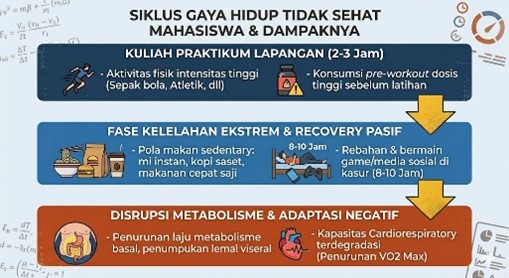
Crisis Metabolism PJKR Students : Systematic Study Effect Supplement Commercial and Sedentary Diets on Cardiorespiratory Physiology
Keywords:
Cardiorespiratory physiology, krisis metabolism, mahasiswa PJKR, pola makan sedentary, suplemen komersialAbstract
In the era of digitalization and transition style modern life today this , literacy health independence and ability adaptation physiological become skills crucial for student education sports , where learning based project kinesiology assessed as the most creative educational strategy For increase capacity However , research previously majority only evaluate fitness athlete without highlight paradox behavior student physical education . This study evaluate impact double consumption supplement commercial No regulated and behavioral sedentary behavior towards degradation capacity heart-lung , especially in the aspect development psychomotor and cognitive student in analyze risk metabolic self . Research This aim analyze in a way systematic effect synergistic between supplement commercial and pattern Eat No active on cardiorespiratory physiology of PJKR students . Using Systematic Literature Review (SLR) method with the PRISMA model, technique data collection based on criteria inclusion in the Scopus and Google Scholar databases is assisted device soft Harzing's Publish or Perish as well as Mendeley for extraction article from range 2018–2026 . Findings show consumption supplement without supervision interact negative with pattern sedentary eating , lowering VO2 max significantly significant , whereas knowledge scaffolding variables nutrition sport proven become factor determinant main pressing risk crisis metabolic , while type sex found No influential significant to level decline The implication is that the PJKR curriculum requires integration of intervention programs activity physique structured to mitigate crisis metabolism and maintain function physiological student in a way sustainable
Downloads
References
Afandi, AA, Sholehah, A., Hasanah, K., & Mas'odi, M. (2025). Literacy Learning Innovation: Effective Strategies to Improve Reading Comprehension in Elementary Schools. Journal of Community Service (ABDIRA) , 5 (3), 459–465. https://doi.org/10.31004/abdira.v5i3.786
Afifah, & N. (2022). The relationship between screen-time duration and sedentary behavior in students in the digital era. Journal of Public Health , 10 (3), 204–215.
Ainsworth, B.E., Haskell, W.L., Herrmann, S.D., Meckes, N., Bassett, D.R., Tudor-Locke, C., Greer, J.L., Vezina, J., Whitt-Glover, M.C., & Leon, A.S. (2011). 2011 compendium of physical activities: A second update of codes and MET values. Medicine and Science in Sports and Exercise , 43 (8), 1575–1581. https://doi.org/10.1249/MSS.0b013e31821ece12
Anwar, & M., S. (2021). Identification of hazardous active chemical ingredients in illegal energy supplements in the environment of sports students. Journal of Medical & Pharmaceutical Analysis , 5 (2), 89–102.
Anwar, MS, Choirudin, & C. (2023). Consumption of instant supplements and its effect on the physical performance of PJKR students. Jurnal Sport Science , 7 (1), 15–28.
Aristovnik, A., Keržič, D., Ravšelj, D., Tomaževič, N., & Umek, L. (2020). Impacts of the COVID-19 pandemic on the lives of higher education students: A global perspective. Sustainability (Switzerland) , 12 (20), 1–34. https://doi.org/10.3390/su12208438
Basri, MH, Masodi, M., Weldani, F., & Prasetyo, DA (2026). Digital-Transformative Outbound Character Engineering for Prospective Physical Education Teachers Based on Experiential Learning (2nd Edition: Foundation and Group Dynamics). In UNU PASURUAN PRESS (Vol. 2, p. 150). https://scholar.google.com/citations?view_op=view_citation&hl=en&user=Flo5L6EAAAAJ&pagesize=100&citation_for_view=Flo5L6EAAAAJ:0EnyYjriUFMC
Booth, F.W., Roberts, C.K., & Laye, M.J. (2012). Lack of exercise is a major cause of chronic diseases. Comprehensive Physiology , 2 (2), 1143–1211. https://doi.org/10.1002/cphy.c110025
Caspersnes, C. . (1985). Powell Physical activity, exercise, and physical fitness definitions, and distinctions for health-related, research. Public Health Rep , 100 (2), 126–131. https://www.ncbi.nlm.nih.gov/pmc/articles/PMC1424733/
Choirudin, C., Afifah, & N. (2024). Kinesiology project-based learning in improving health literacy of sports students. Journal of Physical Education and Sports , 12 (1), 34–45.
Choirudin, & C. (2022). Restructuring the technology-integrated project-based kinesiology learning model for sports students. Journal of Theory and Practice of Education , 14 (2), 110–123.
Curry, A. D. (1972). Toward a theory of instruction. In Studies in Philosophy and Education (Vol. 7, Issue 4). Harvard University Press. https://doi.org/10.1007/BF00368028
Du, C., & Pan, Y. (2011). Optical detection of brain function: Simultaneous imaging of cerebral vascular response, tissue metabolism, and cellular activity in vivo. Reviews in the Neurosciences, 22(6), 695–709. https://doi.org/10.1515/RNS.2011.053
Dwyer, T., Pezic, A., Sun, C., Cochrane, J., Venn, A., Patton, G., Baur, & L. (2015). Objectively measured daily steps and subsequent 5-year change in insulin sensitivity: The AusDiab study. Diabetes Care, 38(3), 425–431. https://doi.org/10.2337/dc14-1188
Ekelund, U., Steene-Johannessen, J., Brown, W. J., Fagerland, M. W., Owen, N., Powell, K. E., Bauman, A., Lee, I. M., Ding, D., Heath, G., Hallal, P. C., Kohl, H. W., Pratt, M., Reis, R., Sallis, J., Aadahl, M., Blot, W. J., Chey, T., Deka, A., … Yi-Park, S. (2016). Does physical activity attenuate, or even eliminate, the detrimental association of sitting time with mortality? A harmonised meta-analysis of data from more than 1 million men and women. The Lancet, 388(10051), 1302–1310. https://doi.org/10.1016/S0140-6736(16)30370-1
Garber, C. E., Blissmer, B., Deschenes, M. R., Franklin, B. A., Lamonte, M. J., Lee, I. M., Nieman, D. C., & Swain, D. P. (2011). Quantity and quality of exercise for developing and maintaining cardiorespiratory, musculoskeletal, and neuromotor fitness in apparently healthy adults: Guidance for prescribing exercise. Medicine and Science in Sports and Exercise, 43(7), 1334–1359. https://doi.org/10.1249/MSS.0b013e318213fefb
Garthe, I., & Maughan, R. J. (2018). Athletes and supplements: Prevalence and perspectives. International Journal of Sport Nutrition and Exercise Metabolism, 28(2), 126–138. https://doi.org/10.1123/ijsnem.2017-0429
Giriwijoyo, S., & Sidik, D. . (2013). The Faal Science of Sport (Exercise Physiology): Human Body Functions on Exercise for Health and Performance. In Bandung: Remaja Rosdakar . PT Remaja Rosdakarya.
Goodway, JD, Ozmun, JC, & Gallahue, DL (nd). Understanding motor development: Infants, children, adolescents, adults . Jones & Bartlett Learning.
Healy, GN, Matthews, CE, Dunstan, DW, Winkler, EAH, & Owen, N. (2011). Sedentary time and cardio-metabolic biomarkers in US adults: NHANES 200306. European Heart Journal , 32 (5), 590–597. https://doi.org/10.1093/eurheartj/ehq451
Hillman, C. H., Erickson, K. I., & Kramer, A. F. (2008). Be smart, exercise your heart: Exercise effects on brain and cognition. Nature Reviews Neuroscience, 9(1), 58–65. https://doi.org/10.1038/nrn2298
Maughan, R. J., Burke, L. M., Dvorak, J., Larson-Meyer, D. E., Peeling, P., Phillips, S. M., Rawson, E. S., Walsh, N. P., Garthe, I., Geyer, H., Meeusen, R., Van Loon, L. J. C., Shirreffs, S. M., Spriet, L. L., Stuart, M., Vernec, A., Currell, K., Ali, V. M., Budgett, R. G., … Engebretsen, L. (2018). IOC consensus statement: Dietary supplements and the high-performance athlete. British Journal of Sports Medicine, 52(7), 439–455. https://doi.org/10.1136/bjsports-2018-099027
Moher, D., Liberati, A., Tetzlaff, J., & Altman, D. G. (2010). Preferred reporting items for systematic reviews and meta-analyses: The PRISMA statement. International Journal of Surgery, 8(5), 336–341. https://doi.org/10.1016/j.ijsu.2010.02.007
Outram, S., Stewart, & B. (2015). Doping through supplements: An overview of the regulatory issues. International Journal of Sport Policy and Politics, 7(1), 115–129. https://doi.org/10.1080/19406940.2014.936316
Owen, N., Healy, G. N., Matthews, C. E., & Dunstan, D. W. (2010). Too much sitting: The population health science of sedentary behavior. Exercise and Sport Sciences Reviews, 38(3), 105–113. https://doi.org/10.1097/JES.0b013e3181e373a2
Page, M. J., McKenzie, J. E., Bossuyt, P. M., Boutron, I., Hoffmann, T. C., Mulrow, C. D., Shamseer, L., Tetzlaff, J. M., Akl, E. A., Brennan, S. E., Chou, R., Glanville, J., Grimshaw, J. M., Hróbjartsson, A., Lalu, M. M., Li, T., Loder, E. W., Mayo-Wilson, E., McDonald, S., … Moher, D. (2021). The PRISMA 2020 statement: An updated guideline for reporting systematic reviews. Bmj, 372, n71. https://doi.org/10.1136/bmj.n71
Pedersen, B. K., & Saltin, B. (2015). Exercise as medicine - Evidence for prescribing exercise as therapy in 26 different chronic diseases. Scandinavian Journal of Medicine and Science in Sports, 25, 1–72. https://doi.org/10.1111/sms.12581
Plowman, M. (2008). Exercise is brain food: The effects of physical activity on cognitive function. Developmental Neurorehabilitation , 11 (3), 236–240. https://doi.org/10.1080/17518420801997007
Praasetyo, DA, Masodi, M., Basri, MH, & Weldani, F. (2026). Simplification of the Basic Theory of Handball. In UNU PASURUAN PRESS (Vol. 3, pp. 1–198). https://scholar.google.com/citations?view_op=view_citation&hl=en&user=Flo5L6EAAAAJ&pagesize=100&citation_for_view=Flo5L6EAAAAJ:WF5omc3nYNoC
Prasetya, A. (2020). Challenges of Adolescent Physical Activity in the Digital Era. Journal of Sports Science , 19 (1), 55–55.
Prasetyo, DA, Masodi, M., Basri, MH, & Weldani, F. (2026). Simplification of the Basic Theory of Handball. In UNU PASURUAN PRESS (Vol. 3, pp. 1–198). https://scholar.google.com/citations?view_op=view_citation&hl=en&user=9BgPsc8AAAAJ&pagesize=100&citation_for_view=9BgPsc8AAAAJ:RYcK_YlVTxYC
Prasetyo, DA, Weldani, F., Masodi, M., & Basri, MH (2026a). Assistance with Dome Tent Installation and Campsite Sanitation Management Based on Topographic Variable Analysis in the Bedengan Campsite Area for PJKR Students. In Journal of Innovation and Development of Community Service Results (Vol. 4, Issue 1, pp. 1–22). https://scholar.google.com/citations?view_op=view_citation&hl=en&user=Flo5L6EAAAAJ&pagesize=100&citation_for_view=Flo5L6EAAAAJ:3fE2CSJIrl8C
Prasetyo, DA, Weldani, F., Masodi, M., & Basri, MH (2026b). Assistance with Dome Tent Installation and Campsite Sanitation Management Based on Topographic Variable Analysis in the Bedengan Campsite Area for PJKR Students. In Journal of Innovation and Development of Community Service Results (Vol. 4, Issue 1, pp. 1–22). https://scholar.google.com/citations?view_op=view_citation&hl=en&user=9BgPsc8AAAAJ&pagesize=100&citation_for_view=9BgPsc8AAAAJ:NhqRSupF_l8C
Rafael, N. V, Kusuma, R., & Weldani, F. (2026). Cardiorespiratory Level of Professional Female Volleyball Athletes Based on VO2max Indicators. In SPRINTER: Journal of Sports Science (Vol. 7, Issue 2, pp. 491–496). https://scholar.google.com/citations?view_op=view_citation&hl=en&user=Flo5L6EAAAAJ&pagesize=100&citation_for_view=Flo5L6EAAAAJ:KlAtU1dfN6UC
Rhomdani, M., Firdaus, NWR, & Prasetyo, DA (2026). The Influence of Limited Facilities and Infrastructure on Physical Education, Sports, and Health Learning at MTS Nurul Huda Talang Saronggi. In SPRINTER: Jurnal Ilmu Olahraga (Vol. 7, Issue 1, pp. 347–354). https://scholar.google.com/citations?view_op=view_citation&hl=en&user=9BgPsc8AAAAJ&pagesize=100&citation_for_view=9BgPsc8AAAAJ:NaGl4SEjCO4C
Serdar, D., & (2015), M. (1995). Physical Fitness. In Choice Reviews Online (Vol. 33, Issue 9). Jogja Global Media.
Swe Dberg, R. (1980). Mind in Society: The Development of Higher Psychological Processes. In Science & Society: A Journal of Marxist Thought and Analysis (Vol. 44, Issue 1). Harvard University Press. https://doi.org/10.1177/003682378004400121
Thomas, D. T., Erdman, K. A., Burke, & L., M. (2016). Nutrition and Athletic Performance. Medicine and Science in Sports and Exercise, 48(3), 543–568. https://doi.org/10.1249/MSS.0000000000000852
Tremblay, M. S., Aubert, S., Barnes, J. D., Saunders, T. J., Carson, V., Latimer-Cheung, A. E., Chastin, S. F. M., Altenburg, T. M., Chinapaw, M. J. M., Aminian, S., Arundell, L., Hinkley, T., Hnatiuk, J., Atkin, A. J., Belanger, K., Chaput, J. P., Gunnell, K., Larouche, R., Manyanga, T., … Wondergem, R. (2017). Sedentary Behavior Research Network (SBRN) - Terminology Consensus Project process and outcome. International Journal of Behavioral Nutrition and Physical Activity , 14(1), 1–17. https://doi.org/10.1186/s12966-017-0525-8
Tucker, J., Fischer, T., Upjohn, L., Mazzera, D., Kumar, & M. (2015). Unapproved pharmaceutical ingredients in dietary supplements: A review of US food and drug administration prescription drug alerts. JAMA Internal Medicine, 175(10), 1669–1677. https://doi.org/10.1001/jamainternmed.2015.3522
Twisk, J. W. R. (2007). Physical Activity and Health. In Paediatric Exercise Physiology: Advances in Sport and Exercise Science series. Human Kinetics. https://doi.org/10.1016/B978-0-443-10260-8.50019-9
Visioli, F., Strata, & A. (2014). Dietary supplements and cardiovascular disease: Is there any evidence of prevention? Annali dell’Istituto Superiore di Sanita, 50(3), 297–302.
W. (2016). WHO Guidelines on physical activity and sedentary behavior. In Routledge Handbook of Youth Sport . World Health Organization. https://www.who.int/publications/i/item/9789240014886%0Ahttps://apps.who.int/iris/bitstream/handle/10665/325147/WHO-NMH-PND-201 9.4-eng.pdf?sequence=1&isAllowed=y%0Ahttp://www.who.int/iris/handle/10665/311664%0Ahttps://apps.who.int/iris/handle/10665/325147
Wawan, W., Anwar, MS, Choirudin, & C. (2023). The fitness paradox: An analysis of sedentary behavior and physical activity of physical education and health students. Journal of Sports and Health , 11 (2), 112–125.
Weldani, F. (2026). AI-Based Evaluation of Basic Sports Skills: A SLR Regarding the Latest in Swimming and Futsal Learning Methodologies in the Framework of SDGs Sustainability. In Journal of Physical Education and Sports Pedagogy (Vol. 1, Issue 1, pp. 49–68). https://scholar.google.com/citations?view_op=view_citation&hl=en&user=Flo5L6EAAAAJ&pagesize=100&citation_for_view=Flo5L6EAAAAJ:_FxGoFyzp5QC
Weldani, F., Mas'odi, M., Prasetyo, DA, & Basri, MH (2026). INCLUSIVE AQUATIC: Transformation of AR and AI Technology in Swimming Learning Based on Madurese Local Wisdom. In UNU Pasuruan Press (Vol. 3, pp. 1–200). https://scholar.google.com/citations?view_op=view_citation&hl=en&user=9BgPsc8AAAAJ&pagesize=100&citation_for_view=9BgPsc8AAAAJ:70eg2SAEIzsC
Weldani, F., & Masodi, M. (2026). Intelligent Instructional Navigation: Development of a Wearable Sensor-Based Adaptive Learning Model to Improve Self-Efficacy and Aquatic Skills. Assyfa Learning Journal , 4 (1), 91–104. https://scholar.google.com/citations?view_op=view_citation%5C&hl=en%5C&user=Su44v60AAAAJ%5C&pagesize=100%5C&citation_for_view=Su44v60AAAAJ:hsZV8lGYWTMC
Weldani, F., Prasetyo, DA, Masodi, M., & Basri, MH (2026). Inclusive Aquatics: Transformation of AR and AI Technology in Swimming Learning Based on Madurese Local Wisdom. In UNU PASURUAN PRESS (Vol. 3, pp. 1–200). https://scholar.google.com/citations?view_op=view_ citation&hl=en&user=Flo5L6EAAAAJ&pagesize=100&citation_for_view=Flo5L6EAAAAJ:LkGwnXOMwfcC
Wood, D., Bruner, J. S., & Ross, G. (1976). the Role of Tutoring in Problem Solving. Journal of Child Psychology and Psychiatry, 17(2), 89–100. https://doi.org/10.1111/j.1469-7610.1976.tb00381.x