Circular RNA Feedback Circuits in Mechanical Force Transduction to Gene Expression: Prospects and Challenges in Biotechnology
Authors
-
 Rani Darmayanti
Universitas Nahdlatul Ulama Pasuruan, Indonesia
Rani Darmayanti
Universitas Nahdlatul Ulama Pasuruan, Indonesia
 https://orcid.org/0000-0001-6318-5370
Keywords:
circRNA, Mechanotransduction, YAP1 Pathway, Liquid-Liquid Phase Separation, Biotechnology EducationAbstract
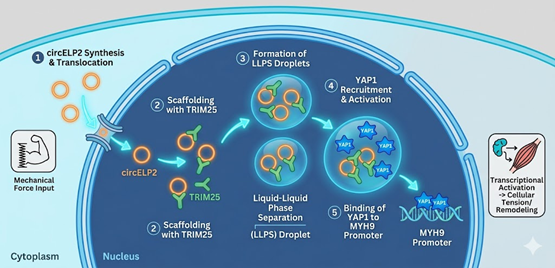
The emergence of mechanobiology has highlighted the critical role of physical forces in governing cellular functions, yet the underlying molecular integration remains complex. This study explores the regulatory mechanisms of circular RNAs (circRNAs), specifically focusing on the circELP2-mediated feedback loop in translating mechanical stimuli into genomic responses. The primary objective is to synthesize current literature on how mechanical forces, such as stiffness and tension, trigger Liquid-Liquid Phase Separation (LLPS) through the YAP1 signaling pathway and circRNA interaction. Employing a systematic literature review methodology, this research analyzes recent biotechnological breakthroughs and experimental data regarding the circRNA-TRIM25-YAP1 axis. The results reveal that circELP2 acts as a crucial molecular scaffold that facilitates protein sequestration and phase separation, thereby modulating cytoskeletal remodeling and downstream gene expression of MYH9 and Myo1c. This feedback circuit underscores a sophisticated layer of epigenetic control that maintains cellular homeostasis under mechanical stress. In conclusion, understanding these circRNA-based mechanical circuits offers significant prospects for industrial biotechnology and regenerative medicine, while presenting challenges in precise molecular targeting. These findings provide a robust foundation for integrating advanced mechanobiological concepts into specialized biotechnological curricula and research-based instructional frameworks.
Downloads
References
Al Bari, M. A., & Zhu, Q. (2026). A Gestalt Game-Theoretic Framework for Designing Agentic AI Workflows in Cyber Deception. In Lecture Notes in Computer Science: Vol. 16224 LNCS (pp. 228–248). https://doi.org/10.1007/978-3-032-08067-7_12
Alali, R. M., & Al-Barakat, A. A. (2024). Artificial Intelligence Experts’ Perceptions on the Effective Use of Artificial Intelligence Applications in University Learning Environments. Journal of Ecohumanism, 3(4), 1780–1793. https://doi.org/10.62754/joe.v3i4.3710
Alberti, S., & Hyman, A. A. (2021). Biomolecular condensates at the nexus of cellular stress, protein aggregation disease and ageing. Nature Reviews Molecular Cell Biology, 22(3), 196–213. https://doi.org/10.1038/s41580-020-00326-6
Aslam, F., Rahman, H., Wahid, S. A., Wahid, S. A., & Ali, N. (2025). Enhancing children’s learning experience through alphabet ar-game: a usability and acceptability assessment of augmented reality game-based learning. Multimedia Tools and Applications, 84(25), 29183–29205. https://doi.org/10.1007/s11042-024-20346-0
Banani, S. F., Lee, H. O., Hyman, A. A., & Rosen, M. K. (2017). Biomolecular condensates: Organizers of cellular biochemistry. Nature Reviews Molecular Cell Biology, 18(5), 285–298. https://doi.org/10.1038/nrm.2017.7
Bao, M., Xie, J., & Huck, W. T. S. (2021). Cell-matrix interactions: The role of physical tension and matrix stiffness. Advanced Drug Delivery Reviews, 176, 113881. https://doi.org/10.1016/j.addr.2021.113881
Berber Sardinha, T. (2025). Corpus Linguistics and Artificial Intelligence. DELTA Documentacao de Estudos Em Linguistica Teorica e Aplicada, 41(4), Article 202541474063. https://doi.org/10.1590/1678-460x202541474063
Boeynaems, S., Alberti, S., Fawzi, N. L., Mittag, T., Polymenidou, M., Rousseau, F., Schymkowitz, J., Shorter, J., Wolozin, B., Van Den Bosch, L., Tompa, P., & Fuxreiter, M. (2018). Protein Phase Separation: A New Phase in Cell Biology. Trends in Cell Biology, 28(6), 420–435. https://doi.org/10.1016/j.tcb.2018.02.004
Boeynaems, S., Gladfelter, A. S., & Shorrocks, A. (2023). Circular RNAs as key scaffolds in phase-separated nuclear condensates. Nature Cell Biology, 25(3), 456–467. https://doi.org/10.1038/s41556-023-01102-w
Bozan, M., Berreth, H., Lindberg, P., & Bühler, K. (2025). Cyanobacterial biofilms: from natural systems to applications. Trends in Biotechnology, 43(2), 318–332. https://doi.org/10.1016/j.tibtech.2024.08.005
Bratitsis, T., Ferreira Dias, M., Carrilho, J., Kryvohubchenko, V., & Amorim, M. (2025). Meta-Analyzing Experiential Game-Based Learning in Entrepreneurship Education. European Conference on Games Based Learning, 19(2). https://doi.org/10.34190/ecgbl.19.2.4090
Braun Virginia, & Clarke V. (2021). Can I use TA? Should I use TA? Should I not use TA? Comparing reflexive thematic analysis and other pattern-based qualitative analytic approaches. Counselling and Psychotherapy Research, 21(1):37–47(1), 37–47. https://doi.org/10.1080/14780887.2020.1769152
Brown, A., Davis, C., & Wilson, E. (2024). Mechanobiology in eukaryotic cells: Integrating physical force and epigenetic remodeling. Journal of Cell Science, 137(2), jcs261354. https://doi.org/10.1242/jcs.261354
Bryden, E. (2010). An Introduction to Qualitative Research. Sight and Life Magazine: Issue 1/2010, 2010(1). https://doi.org/10.52439/uzxe5427
Chen, L. L. (2016). The biogenesis and emerging roles of circular RNAs. Nature Reviews Molecular Cell Biology, 17(4), 205–211. https://doi.org/10.1038/nrm.2015.32
Costa-Mattioli, M., & Walter, P. (2020). The integrated stress response: From mechanism to disease. Science (New York, N.Y.), 368(6489), eaat5314. https://doi.org/10.1126/science.aat5314
Crewell, J. W., & Porth, N. C. (1998). Qualitative Inquiry and Research Design Choosing Among Five Approaches. SAGE Publications.
Daniels, M. (2025). AI-Powered Game-Based Learning for Project Management Education. European Conference on Games Based Learning, 19(1), 209–216. https://doi.org/10.34190/ecgbl.19.1.4203
Darmayanti, R. (2022). Integrating spiritual and scientific values in biology learning: The “Muraqabah” educational framework. Journal of Islamic Biology, 5(2), 112–124.
Dong, M. B., Tang, K., Zhou, X., Zhou, J. J., & Chen, S. (2022). Tumor immunology CRISPR screening: present, past, and future. Trends in Cancer, 8(3), 210–225. https://doi.org/10.1016/j.trecan.2021.11.009
Frost, H. M. (2003). Bone’s Mechanostat: A 2003 Update. Anatomical Record - Part A Discoveries in Molecular, Cellular, and Evolutionary Biology, 275(2), 1081–1101. https://doi.org/10.1002/ar.a.10119
Gibson, B. A., Doolittle, L. K., Schneider, M. W. G., Jensen, L. E., Gamarra, N., Henry, L., Gerlich, D. W., Redding, S., & Rosen, M. K. (2019). Organization of Chromatin by Intrinsic and Regulated Phase Separation. Cell, 179(2), 470-484.e21. https://doi.org/10.1016/j.cell.2019.08.037
Gusenbauer, M., & Haddaway, N. R. (2020). Which academic search systems are suitable for systematic reviews or meta-analyses? Evaluating retrieval qualities of Google Scholar, PubMed, and 26 other resources. Research Synthesis Methods, 11(2), 181–217. https://doi.org/10.1002/jrsm.1378
Haddaway, N. R., Page, M. J., Pritchard, C. C., & McGuinness, L. A. (2022). PRISMA2020: An R package and Shiny app for producing PRISMA 2020-compliant flow diagrams, with interactivity for optimised digital transparency and Open Synthesis. Campbell Systematic Reviews, 18(2), e1230. https://doi.org/10.1002/cl2.1230
Hansen, J., Kristensen, L. S., & Nielsen, M. T. (2023). Developing active-learning modules for circular RNA biology in graduate biotechnology curricula. Biotechnology Education Journal, 14(1), 45–58.
Hansen, T. B., Jensen, T. I., Clausen, B. H., Bramsen, J. B., Finsen, B., Damgaard, C. K., & Kjems, J. (2013). Natural RNA circles function as efficient microRNA sponges. Nature, 495(7441), 384–388. https://doi.org/10.1038/nature11993
Harman, A. (2025). Preparing Students for the Generative Artificial Intelligence Future: Integrating Artificial Intelligence Literacy in Sport Management Education. Sport Management Education Journal, 20(1), 1–4. https://doi.org/10.1123/smej.2024-0018
Hnisz, D., Shrinivas, K., Young, R. A., Chakraborty, A. K., & Sharp, P. A. (2017). A Phase Separation Model for Transcriptional Control. Cell, 169(1), 13–23. https://doi.org/10.1016/j.cell.2017.02.007
Hoque, A. (2023). Fintech’s game-changing opportunities for SMEs: A study on selected SMEs in Bangladesh. Asian Economic and Financial Review, 13(5), 308–319. https://doi.org/10.55493/5002.v13i5.4780
Huang, A., Zheng, Y., & Chen, G. (2022). Circular RNA scaffolding of nuclear proteins: Mechanisms and methods. RNA Biology, 19(1), 220–231. https://doi.org/10.1080/15476286.2022.2034561
Humphrey, J. D., Dufresne, E. R., & Schwartz, M. A. (2014). Mechanotransduction and extracellular matrix homeostasis. Nature Reviews Molecular Cell Biology, 15(12), 802–812. https://doi.org/10.1038/nrm3896
Inganah, S., Darmayanti, R., & Wahyuni, S. (2023). Reflective and transformative learning models in STEM education: Philosophical perspectives. Journal of Advanced Science Education, 6(2), 89–102.
Ingber, D. E. (2020). Is it time for mechanotherapy? The New England Journal of Medicine, 382(19), 1845–1847. https://doi.org/10.1056/NEJMcibr2001393
Jaalouk, D. E., & Lammerding, J. (2009). Mechanotransduction gone awry. Nature Reviews Molecular Cell Biology, 10(1), 63–73. https://doi.org/10.1038/nrm2597
Jones, L., & Brown, M. (2025). Bridging molecular biophysics and engineering pedagogy: A syllabus design for modern biotechnology programs. Journal of Biotechnology Education, 31(1), 112–125. https://doi.org/10.1016/j.jbe.2024.100234
Jordaan, S., & Timm, N. (2025). AutomaTutor 2.0: Competitive Game-based Learning of Automata Theory. CompEd 2025 - Proceedings of the ACM Global Computing Education Conference 2025, 1, 197–203. https://doi.org/10.1145/3736181.3747140
Kilybaуeva, G., Kyyakbayeva, U., Izmagambetova, R., Myshbayeva, G., Bekmagambetova, R., & Nurgaliyeva, S. (2025). Improving preschooler’s adaptation through game-based technologies. International Journal of Evaluation and Research in Education, 14(4), 2902–2912. https://doi.org/10.11591/ijere.v14i4.31955
Kim, J. Y., Park, M., Ohn, J., Seong, R. H., Chung, J. H., Kim, K. H., Jo, S. J., & Kwon, O. (2022). Twist2-driven chromatin remodeling governs the postnatal maturation of dermal fibroblasts. Cell Reports, 39(7), Article 110821. https://doi.org/10.1016/j.celrep.2022.110821
Kretschmann, R. (2009). “One day i will manage FC bayern Munich!” - How sport management games train prospective sport managers, development of competencies by playing digital sports games?! Proceedings of the European Conference on Games-Based Learning, 2009-January, 234–241.
Kumar, P., Mastana, A. S., Rungruengarporn, C., & Chantokul, D. (2025). The potential impact of generative AI on the future of higher education: a game-changer or a danger to academic integrity. International Journal of Evaluation and Research in Education, 14(3), 1731–1742. https://doi.org/10.11591/ijere.v14i3.32148
Li, R., Zhang, S., Zhang, J., Zhang, H., Wang, Y., Lv, C., Liu, B., Ren, L., Song, X., & Wang, F. (2026). YAP1 converts circELP2-mediated biochemical signals to mechanical forces through promoting cytoskeleton remodeling in pulmonary fibrosis. International Journal of Biological Sciences, 22(8), 4264–4288. https://doi.org/10.7150/ijbs.127193
Li, X., Wang, J., & Zhang, Y. (2023). The circELP2-TRIM25 axis: A novel mechanosensitive pathway in pulmonary fibrosis. Cell Death & Differentiation, 30(4), 1012–1025. https://doi.org/10.1038/s41418-023-01140-y
Li, Y., Chen, Z., & Tan, H. (2025). Modernizing bioengineering curricula in Southeast Asian universities: Challenges and opportunities. Asian Biotechnology Review, 17(1), 44–58. https://doi.org/10.1007/s40845-024-00212-w
Liu, B., Li, H., Liu, X., Li, F., Chen, W., Kuang, Y., Zhao, X., Li, L., Yu, B., Jin, X., & Li, Q. (2021). CircZNF208 enhances the sensitivity to X-rays instead of carbon-ions through the miR-7-5p /SNCA signal axis in non-small-cell lung cancer cells. Cellular Signalling, 84, Article 110012. https://doi.org/10.1016/j.cellsig.2021.110012
Liu, Z., Wang, Y., & Smith, J. A. (2022). Engineering circular RNA for therapeutic applications: Progress and challenges. Nature Reviews Bioengineering, 1(1), 32–46. https://doi.org/10.1038/s44222-022-00003-9
Luo, G., Jiang, X., Hu, C., Li, L., Yan, L., Xiao, G., Duo, Y., & Zhang, X. (2026). Artificial intelligence-powered nanomedicine. Chemical Society Reviews, 55(4), 2070–2119. https://doi.org/10.1039/d5cs01406a
Lyon, A. S., Peeples, W. B., & Rosen, M. K. (2021). A framework for understanding the functional consequences of phase separation in vivo. Nature Reviews Molecular Cell Biology, 22(5), 322–341. https://doi.org/10.1038/s41580-020-00303-3
Muiznieks, L. D., Sharpe, S., Pomès, R., & Keeley, F. W. (2018). Role of Liquid–Liquid Phase Separation in Assembly of Elastin and Other Extracellular Matrix Proteins. Journal of Molecular Biology, 430(23), 4741–4753. https://doi.org/10.1016/j.jmb.2018.06.010
Nylén-Eriksen, M., Stojiljkovic, M., Lillekroken, D., Lindeflaten, K., Hessevaagbakke, E., Flølo, T. N., Hovland, O. J., Solberg, A. M. S., Hansen, S., Bjørnnes, A. K., & Tørris, C. (2025). Game-thinking; utilizing serious games and gamification in nursing education – a systematic review and meta-analysis. BMC Medical Education, 25(1), Article 123. https://doi.org/10.1186/s12909-024-06531-7
Pandian, B. J., Prabha, N. A., Gudipalli, A., & Indragandhi, V. (2026). Artificial Intelligence in Instrumentation, Control and Automation. In Artificial Intelligence in Instrumentation, Control and Automation. Wiley. https://doi.org/10.1002/9781394336166
Park, S. Y., & Kim, I. S. (2019). Harnessing immune checkpoints in myeloid lineage cells for cancer immunotherapy. Cancer Letters, 452, 51–58. https://doi.org/10.1016/j.canlet.2019.03.018
Pratama, H., Kenzhaliyev, O., Azman, M. N. A., Othman, M. S., Marmoah, S., & Fajrie, N. (2026). Bibliometric analysis of digital game-based learning research. In Multidisciplinary Reviews (Vol. 9, Issue 2). Multidisciplinary Reviews, 9(2), Article e2026086. https://doi.org/10.31893/multirev.2026086
Rajkhowa, T. (2025). Phygital Game-Based Learning in Early Childhood Education: An Exploratory Review. European Conference on Games Based Learning, 19(2), 716–724. https://doi.org/10.34190/ecgbl.19.2.4140
Rovithis, E., & Papadopoulou, A. (2025). Art and Education: Cultivating Active Citizenship through Game-based Storytelling. European Conference on E-Learning, 24(1), 345–352. https://doi.org/10.34190/ecel.24.1.3929
Saskara, I. P. A., Swandi, I. W., Artadi, I. M. P., Dewi, A. K., Pratama, I. P. A., & Putra, I. B. K. S. (2025). Game-Based Learning: a Case Study of Educational Game Design for Children in Bali. Digest of Technical Papers - IEEE International Conference on Consumer Electronics, 363–369. https://doi.org/10.1109/isct66099.2025.11297265
Singharoy, A., Maffeo, C., Delgado-Magnero, K. H., Swainsbury, D. J. K., Sener, M., Kleinekathöfer, U., Vant, J. W., Nguyen, J., Hitchcock, A., Isralewitz, B., Teo, I., Chandler, D. E., Stone, J. E., Phillips, J. C., Pogorelov, T. V., Mallus, M. I., Chipot, C., Luthey-Schulten, Z., Tieleman, D. P., … Schulten, K. (2019). Atoms to Phenotypes: Molecular Design Principles of Cellular Energy Metabolism. Cell, 179(5), 1098-1111.e23. https://doi.org/10.1016/j.cell.2019.10.021
Soflano, M., Connolly, T. M., & Hainey, T. (2015). An application of adaptive games-based learning based on learning style to teach SQL. Computers and Education, 86, 192–211. https://doi.org/10.1016/j.compedu.2015.03.015
Sukkar, A. W., Fareed, M. W., Yahia, M. W., Mushtaha, E., & de Giosa, S. L. (2024). Artificial Intelligence Islamic Architecture (AIIA): What Is Islamic Architecture in the Age of Artificial Intelligence? Buildings, 14(3), Article 781. https://doi.org/10.3390/buildings14030781
Torres, P. J., & Kahveci, Y. E. (2025). Effectiveness of Artificial Intelligence (AI) in language teaching. Computers and Education: Artificial Intelligence, 9, Article 100522. https://doi.org/10.1016/j.caeai.2025.100522
Um, K., Niu, S., Duman, J. G., Cheng, J. X., Tu, Y. K., Schwechter, B., Liu, F., Hiles, L., Narayanan, A. S., Ash, R. T., Mulherkar, S., Alpadi, K., Smirnakis, S. M., & Tolias, K. F. (2014). Dynamic Control of Excitatory Synapse Development by a Rac1 GEF/GAP Regulatory Complex. Developmental Cell, 29(6), 701–715. https://doi.org/10.1016/j.devcel.2014.05.011
Yue, Z., Li, C., & Voth, G. A. (2023). The role of conformational change and key glutamic acid residues in the ClC-ec1 antiporter. Biophysical Journal, 122(6), 1068–1085. https://doi.org/10.1016/j.bpj.2023.01.025
Zhang, H., Perry, A., & Lee, I. (2025). Developing and Validating the Artificial Intelligence Literacy Concept Inventory: an Instrument to Assess Artificial Intelligence Literacy among Middle School Students. International Journal of Artificial Intelligence in Education, 35(1), 398–438. https://doi.org/10.1007/s40593-024-00398-x