The Role of Islamic Financial Literacy and Digital Financial Inclusion in Improving Saving Decisions among Unbanked Communities: An Empirical Study
Article Sidebar
Main Article Content
Abstract
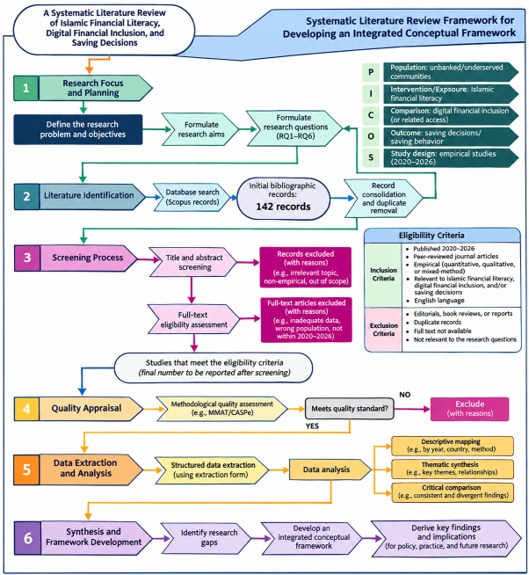
Islamic financial literacy and digital financial inclusion play an increasingly important role in expanding access to formal financial services, particularly among unbanked communities. Despite the growing availability of digital financial services, limited financial knowledge, technological barriers, and inadequate access to Islamic financial institutions remain significant challenges in encouraging saving behavior. This study aims to examine the relationship between Islamic financial literacy, digital financial inclusion, and saving decisions among unbanked communities through a systematic literature review. The study synthesizes findings from previously published empirical research, focusing on the conceptual relationships, influencing factors, and research trends associated with Islamic financial literacy and digital financial inclusion. Relevant studies are identified through academic databases and selected based on predefined inclusion and exclusion criteria. The analysis employs thematic synthesis to identify recurring patterns, research gaps, and the mechanisms through which financial literacy and digital financial access may influence saving decisions. The expected contribution of this study is to develop an integrated understanding of the role of Islamic financial literacy and digital financial inclusion in strengthening financial participation and saving behavior among underserved communities. The findings are expected to provide insights for Islamic financial institutions, policymakers, and financial service providers in developing more inclusive, accessible, and sustainable financial strategies
Downloads
Article Details

This work is licensed under a Creative Commons Attribution-ShareAlike 4.0 International License.
References
Aisyah, E. N., Pratikto, H., Wardoyo, C., & Restuningdiah, N. (2024). The right literacy on the right performance: Does Islamic financial literacy affect business performance through Islamic financial inclusion? Journal of Social Economics Research, 11(3), 275–289. https://doi.org/10.18488/35.v11i3.3766
Ajzen, I. (1991). The theory of planned behavior. Organizational Behavior and Human Decision Processes, 50(2), 179–211. https://doi.org/10.1016/0749-5978(91)90020-T
Barus, E. E., Syahrial, M., Muchtar, E. H., & Trianto, B. (2024). Islamic financial literacy, Islamic financial inclusion and micro-business performance. Revista Mexicana de Economía y Finanzas, 19(1). https://doi.org/10.21919/remef.v19i1.967
Fadilah, A. N., & Lubis, D. (2024). The influence of Islamic financial literacy, Islamic financial inclusion, and financial behavior on the investment decisions of Generation Z in West Java. Falah: Jurnal Ekonomi Syariah, 9(1), 1–16. https://doi.org/10.22219/jes.v9i1.29286
Fatah, M. I. (2025). Literasi keuangan syariah dan keputusan menabung di bank syariah: Sebuah tinjauan sistematis dan agenda riset masa depan. Economic: Jurnal Ekonomi dan Hukum Islam, 16(1). https://doi.org/10.59943/5ca9fv92
Frizky, M. Y., & Canggih, C. (2025). What drives Muslims to continue using e-wallet in the future? A case study of Surabaya. Review of Islamic Economics and Finance, 8(1), 103–124. https://doi.org/10.17509/rief.v8i1.81423
Hasbiah, Aisyah, N. Y. P., Karfin, Ladaku, R. H., & Awaluddin, S. P. (2025). Building Islamic financial literacy in Papua: Opportunities and challenges. Daengku, 5(6), 842–848. https://doi.org/10.35877/454RI.daengku4639
Khamis, F. M., Isa, M. Y. B., & Yusuff, N. B. (2024). Perceived inclusion of Islamic finance: The effects of attitudes, experience, literacy, religiosity, and social influences. International Journal of Applied Economics, Finance and Accounting, 18(2), 321–338. https://doi.org/10.33094/ijaefa.v18i2.1398
Marhadi, M., Fathoni, A. F., Setiawan, B., Pratiwi, D., Hayati, R., Boros, A., & Sudibyo, N. A. (2024). Continuance intention of Fintech Peer-to-Peer (P2P) financing Shariah: Moderation role of brand schematicity and digital financial literacy. Journal of Open Innovation: Technology, Market, and Complexity, 10(2), 100301. https://doi.org/10.1016/j.joitmc.2024.100301
Mujiatun, S., Trianto, B., Cahyono, E. F., & Rahmayati. (2023). The impact of marketing communication and Islamic financial literacy on Islamic financial inclusion and MSMEs performance: Evidence from halal tourism in Indonesia. Sustainability, 15(13), 9868. https://doi.org/10.3390/su15139868
Page, M. J., McKenzie, J. E., Bossuyt, P. M., Boutron, I., Hoffmann, T. C., Mulrow, C. D., Shamseer, L., Tetzlaff, J. M., Akl, E. A., Brennan, S. E., Chou, R., Glanville, J., Grimshaw, J. M., Hróbjartsson, A., Lalu, M. M., Li, T., Loder, E. W., Mayo-Wilson, E., McDonald, S., ... Moher, D. (2021). The PRISMA 2020 statement: An updated guideline for reporting systematic reviews. BMJ, 372, n71. https://doi.org/10.1136/bmj.n71
Rahmatia, A., Wijaya, A. P., Saputra, A. D., & Ma’ruf, M. I. (2022). Islamic financial literacy: Evidence from Indonesian urban middle-class women. Journal of Islamic Economic Laws, 5(2), 199–215. https://doi.org/10.23917/jisel.v5i2.18467
Rethlefsen, M. L., Kirtley, S., Waffenschmidt, S., Ayala, A. P., Moher, D., Page, M. J., & Koffel, J. B. (2021). PRISMA-S: An extension to the PRISMA statement for reporting literature searches in systematic reviews. Systematic Reviews, 10, Article 39. https://doi.org/10.1186/s13643-020-01542-z
Rohmah, R. N., & Canggih, C. (2026). Determinants of saving behavior in Islamic banks: The role of financial literacy, social influence, and moral identity with digitalization as moderator. Review of Islamic Economics and Finance, 9(1), 59–74. https://doi.org/10.17509/rief.v9i1.97604
Rozalinda, Afrida, Y., Abdullah, I., Prasojo, Z. H., Ulfah, M., Saka, P. A., & Nelli, J. (2024). Economic empowerment of unbanked women through financial inclusion in Indonesia. Cogent Business & Management, 11(1). https://doi.org/10.1080/23311975.2024.2407921
Setiawati, R., Wediawati, B., Amin, S., Junaidi, J., & Yacob, S. (2025). Islamic financial literacy among Indonesian students: An analysis of knowledge, attitudes, and behavior. Global Business and Finance Review, 30(9), 109–125. https://doi.org/10.17549/gbfr.2025.30.9.109
Snyder, H. (2019). Literature review as a research methodology: An overview and guidelines. Journal of Business Research, 104, 333–339. https://doi.org/10.1016/j.jbusres.2019.07.039
Sofiani, T., Ahmad, S. B., Pratami, B. D., & Suhendar, H. (2025). Mosques as catalysts for Islamic financial inclusion: Evidence from branchless banking implementations. Asy-Syari’ah, 27(2), 143–170. https://doi.org/10.15575/as.v27i2.48309
Wijaya, H. R., Hati, S. R. H., Ekaputra, I. A., & Kassim, S. (2024). The impact of religiosity and financial literacy on financial management behavior and well-being among Indonesian Muslims. Humanities and Social Sciences Communications, 11(1). https://doi.org/10.1057/s41599-024-03309-6
Xiao, Y., & Watson, M. (2019). Guidance on conducting a systematic literature review. Journal of Planning Education and Research, 39(1), 93–112. https://doi.org/10.1177/0739456X17723971