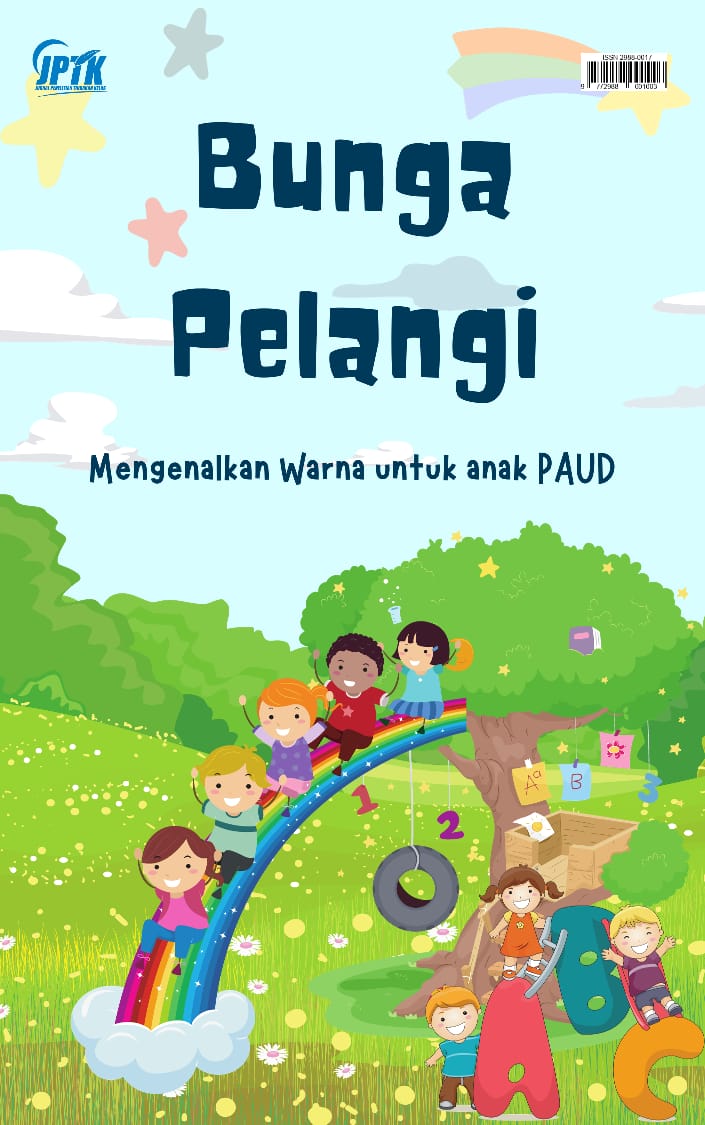
Bagaimana konsep warna diperkenalkan dengan media Bunga Pelangi?
DOI:
https://doi.org/10.61650/jptk.v1i2.221Keywords:
Bunga Pelangi, Konsep Warna, PAUD, Media PembelajaranAbstract
Mengenal konsep warna merupakan bagian penting dari perkembangan kognitif anak, terutama pada usia empat tahun. Penelitian ini mengkaji implementasi “Bunga Pelangi” sebagai media pembelajaran dalam mengenalkan konsep warna kepada anak-anak di PAUD YALC Pasuruan. “Bunga Pelangi” adalah alat bantu visual berbentuk bunga dengan kelopak berwarna-warni yang dirancang untuk menarik perhatian dan memudahkan anak memahami warna dasar. Penelitian tindakan kelas ini terdiri dari empat tahap, yaitu perencanaan, pelaksanaan, observasi, dan refleksi, yang dilakukan dalam tiga siklus. Sepuluh siswa PAUD YALC Pasuruan dipilih sebagai subjek penelitian. Data dikumpulkan melalui observasi langsung, wawancara dengan guru, dan penilaian kinerja anak selama proses pembelajaran. Hasil penelitian menunjukkan peningkatan pemahaman konsep warna pada setiap siklus pertandingan, dengan peningkatan rata-rata pemahaman sebesar 25% pada siklus pertama, 45% pada siklus kedua, dan 65% pada siklus ketiga. Berdasarkan skor penilaian, dapat disimpulkan bahwa penggunaan perangkat pembelajaran “Bunga Pelangi” efektif dalam membantu anak-anak mengenal konsep warna secara umum. Keterbatasan penelitian ini adalah ukuran sampel yang kecil dan pengamatan yang terbatas pada satu PAUD, yang mungkin mempengaruhi generalisasi hasil. Implikasi praktis dari penelitian ini adalah bahwa media “Bunga Pelangi” dapat diadopsi oleh lembaga pendidikan anak usia dini lainnya untuk meningkatkan pemahaman konsep warna pada anak
Downloads
References
Abus, O. (2023). TAYO Cards in Understanding Numbers 1-10 for Early Childhood, Improve? Journal of Teaching and Learning Mathematics, 1, 13–24.
Acar, D. (2022). “Engineer” Perception in Early Childhood. Journal of Turkish Science Education, 19(4), 1222–1236. https://doi.org/10.36681/tused.2022.171
Acker, A., Nyland, B., Deans, J., Payman, K., & Klarin, S. (2022). Music Composition in Contexts of Early Childhood: Creation, Communication and Multi-Modal Experiences through Music. In Music Composition in Contexts of Early Childhood: Creation, Communication and Multi-Modal Experiences through Music. Springer International Publishing. https://doi.org/10.1007/978-3-030-91692-3
Arndt, S. (2018). Early childhood teacher cultural Otherness and belonging. Contemporary Issues in Early Childhood, 19(4), 392–403. https://doi.org/10.1177/1463949118783382
Barr, R., & Linebarger, D. N. (2016). Media exposure during infancy and early childhood: The effects of content and context on learning and development. In Media Exposure During Infancy and Early Childhood: The Effects of Content and Context on Learning and Development. Springer International Publishing. https://doi.org/10.1007/978-3-319-45102-2
Budiarti, E. (2024). Exploratory activities for early childhood: Utilizing smartphone technology to enhance early childhood creativity, effective? Assyfa Journal of Multidisciplinary Education, 1.
Capio, C. M., Cheung, S. K., Fung, S. S. W., & Hu, X. (2024). Integrating Fundamental Movement Skills and Mathematics in Early Childhood: A Pilot Study. Children, 11(4). https://doi.org/10.3390/children11040457
Darmayanti, R. (2023). ATM sebagai bahan ajar dalam membantu pemahaman bilangan PI siswa SD, matematikanya dimana? Jurnal Penelitian Tindakan Kelas, 1(2).
Davis, G. A., & Tu, T.-H. (2008). Mathematics and science in the early years: International perspectives and theoretical views. In Early Childhood Education: Issues and Developments (pp. 24–45). Nova Science Publishers, Inc. https://www.scopus.com/inward/record.uri?eid=2-s2.0-84901601527&partnerID=40&md5=227c6c736d4041b312c191b52fa9721c
DiGirolamo, A. M., Ochaeta, L., & Flores, R. M. M. (2020). Early Childhood Nutrition and Cognitive Functioning in Childhood and Adolescence. Food and Nutrition Bulletin, 41(1_suppl), S31–S40. https://doi.org/10.1177/0379572120907763
Giaretton, D. W. L., da Rosa Olesiak, L., München, M. A. B., & Quintana, A. M. (2020). School’s position on death and childhood: (De)construction of silent walls. Revista Brasileira de Educacao, 25. https://doi.org/10.1590/S1413-24782020250035
Gibbons, A. (2015). Debating Digital Childhoods: Questions concerning technologies, economies and determinisms. Open Review of Educational Research, 2(1), 118–127. https://doi.org/10.1080/23265507.2015.1015940
Gjelaj, M., Buza, K., Shatri, K., & Zabeli, N. (2020). Digital technologies in early childhood: Attitudes and practices of parents and teachers in Kosovo. International Journal of Instruction, 13(1), 165–184. https://doi.org/10.29333/iji.2020.13111a
Haga, M. (2021). Body and movement in early childhood; spaces for movement-based play. Journal of Physical Education and Sport, 21, 526–529. https://doi.org/10.7752/jpes.2021.s1057
Haynes, L., Ip, A., Cho, I. Y. K., Dimond, D., Rohr, C. S., Bagshawe, M., Dewey, D., Lebel, C., & Bray, S. (2020). Grey and white matter volumes in early childhood: A comparison of voxel-based morphometry pipelines. Developmental Cognitive Neuroscience, 46. https://doi.org/10.1016/j.dcn.2020.100875
Kim, S.-W., & Youn, J.-J. (2016). Analysis of the conceptual diagrams of preservice early childhood teachers on early childhood mathematics education. Indian Journal of Science and Technology, 9(41). https://doi.org/10.17485/ijst/2016/v9i41/103848
Kraftl, P. (2020). After childhood: Re-thinking environment, materiality and media in children’s lives. In After Childhood: Re-thinking Environment, Materiality and Media in Children’s Lives. Taylor and Francis. https://doi.org/10.4324/9781315110011
Kusumaningsih, D., Wibawa, S. A., & Lestari, J. T. (2024). Mengapa guru bahasa Inggris mengajar bahasa Indonesia? Pendapat siswa EFL tentang bahasa Indonesia di kelas bahasa Inggris. Jurnal Penelitian Tindakan Kelas, 3.
Lestari, W. P., Ningsih, E. F., Choirudin, C., Sugianto, R., & Lestari, A. S. B. (2023). Efektivitas Model Pembelajaran Kooperatif Dengan Pendekatan Contextual Teaching and Learning (CTL) Terhadap Hasil Belajar Matematika. Jurnal Penelitian Tindakan Kelas, 1, 28–33.
Lewis, A. (2019). Examining the concept of well-being and early childhood: Adopting multi-disciplinary perspectives. Journal of Early Childhood Research, 17(4), 294–308. https://doi.org/10.1177/1476718X19860553
Lubis, M., Solehudin, R. H., & Safitri, N. D. (2024). Seberapa “pengaruh” media, fasilitas, dan minat belajar terhadap hasil belajar ekonomi siswa? Jurnal Penelitian Tindakan Kelas, 1(3).
Muhammad, I., Angraini, L. M., Darmayanti, R., Sugianto, R., Usmiyatun, U., & ... (2023). Students’ Interest in Learning Mathematics Using Augmented Reality: Rasch Model Analysis. Edutechnium Journal of Educational Technology, 1(1), 89–99.
Mustakim, A., Wawan, W., Choirudin, C., Ngaliyah, J., & Darmayanti, R. (2023). Quantum Teaching Model: Untuk Meningkatkan Hasil Belajar Matematika Siswa MTs. Jurnal Penelitian Tindakan Kelas, 1(1), 6–10.
Navarra, G. A., Scardina, A., Thomas, E., Battaglia, G., Agnese, M., Proia, P., Palma, A., & Bellafiore, M. (2022). How Does the Amount of a Physical Education Intervention Affect Gross Motor Coordination in Early Childhood? Journal of Functional Morphology and Kinesiology, 7(4). https://doi.org/10.3390/jfmk7040096
O’Toole, L., McClelland, D., Forde, D., O’Keeffe, S., Purdy, N., Säfström, C. A., & Walsh, T. (2021). Contested childhoods across borders and boundaries: Insights from curriculum provisions in Northern Ireland and the Irish Free State in the 1920s. British Educational Research Journal, 47(4), 1021–1038. https://doi.org/10.1002/berj.3708
Pandia, W. S. S., Naim, M. A., & Siddique, M. (2023). Student growth, qualities, and abilities in developing religious ideals from childhood. Which approach works? Assyfa Journal of Islamic Studies, 1.
Rahmawati, I., Anwar, M. S., Saputra, A. A., & Fauza, M. R. (2023). Implementasi Pendidikan Karakter Dalam Proses Pembelajaran Matematika Kelas X MA Maâ€TMarif Roudlotut Tholibin Kota Metro. Jurnal Penelitian Tindakan Kelas, 2, 91–105.
Rizdania, R., Riono, S. H., Rakhmawati, P. U., & Darmayanti, R. (2023). Interns: Mentoring and Counseling on the Software Development Process. Jurnal Inovasi Dan Pengembangan Hasil Pengabdian Masyarakat, 1, 22–29.
Robertson, S.-A., & Graven, M. (2020). A mathematics teacher’s response to a dilemma: ‘i’m supposed to teach them in English but they don’t understand.’ South African Journal of Childhood Education, 10(1). https://doi.org/10.4102/sajce.v10i1.800
Safitri, E., Setiawan, A., & Darmayanti, R. (2023a). Eksperimentasi Model Pembelajaran Problem Based Learning Berbantuan Kahoot Terhadap Kepercayaan Diri Dan Prestasi Belajar. Jurnal Penelitian Tindakan Kelas, 1(2), 57–61.
Safitri, E., Setiawan, A., & Darmayanti, R. (2023b). Eksperimentasi Model Pembelajaran Problem Based Learning Berbantuan Kahoot Terhadap Kepercayaan Diri Dan Prestasi Belajar. Jurnal Penelitian Tindakan Kelas, 2, 57–61.
Safitri, E., Setiawan, A., Darmayanti, R., & Wardana, M. R. F. (2023). Pinokio dalam Pembelajaran Matematika Materi Geometri untuk Siswa SMP. Jurnal Penelitian Tindakan Kelas, 1(2), 106–113.
Safitri, N. D., Afifah, A., & Rahmah, K. (2023). Bagaimana konsep warna diperkenalkan dengan media Bunga Pelangi? Jurnal Penelitian Tindakan Kelas, 2.
Schmutz, E. A., Leeger-Aschmann, C. S., Kakebeeke, T. H., Zysset, A. E., Messerli-Bürgy, N., Stülb, K., Arhab, A., Meyer, A. H., Munsch, S., Puder, J. J., Jenni, O. G., & Kriemler, S. (2020). Motor Competence and Physical Activity in Early Childhood: Stability and Relationship. Frontiers in Public Health, 8. https://doi.org/10.3389/fpubh.2020.00039
Segara, B., Choirudin, C., Setiawan, A., Anwar, M. S., & Arif, V. R. (2023). Metode Inquiry: Meningkatkan Hasil Belajar Matematika Siswa SMP Pada Materi Luas Bangun Datar. JUrnal Penelitian Tindakan Kelas, 1, 18–22.
Sharmahd, N., & Peeters, J. (2019). Critical reflection, identity, interaction : Italian and Belgian experiences in building democracy through pedagogical documentation. In Understanding Pedagogic Documentation in Early Childhood Education : Revealing and Reflecting on High Quality Learning and Teaching (pp. 52–66). Taylor and Francis. https://doi.org/10.4324/9780429030055-4
Solehudin, R. H., & Darmayanti, R. (2018). What are the main lessons from Indonesia’s CSR financial literacy education investment for early childhood? Jurnal Caksana: Pendidikan Anak Usia Dini, 1(1), 95–106.
Srisuk, K. (2023). Guidelines for reforming early childhood teacher production and development systems by applying competencies effecting the early childhood-Based conceptual innovation development. Kasetsart Journal of Social Sciences, 44(1), 169–180. https://doi.org/10.34044/j.kjss.2023.44.1.19
Strauss, A. M., Tolmen, P. S., & Bipath, K. (2023). A critical multimodal discourse analysis of drawings to ascertain identity and self-concept. South African Journal of Childhood Education, 13(1). https://doi.org/10.4102/sajce.v13i1.1240
Syaifuddin, M., Darmayanti, R., & Rizki, N. (2022). Development of a two-tier multiple-choice (TTMC) diagnostic test for geometry materials to identify misconceptions of middle school students. Jurnal Silogisme: Kajian Ilmu Matematika Dan Pembelajarannya, 7(2).
Symonds, J. D., Zuberi, S. M., Stewart, K., McLellan, A., O’Regan, M., MacLeod, S., Jollands, A., Joss, S., Kirkpatrick, M., Brunklaus, A., Pilz, D. T., Shetty, J., Dorris, L., Abu-Arafeh, I., Andrew, J., Brink, P., Callaghan, M., Cruden, J., Diver, L. A., … Wilson, M. (2019). Incidence and phenotypes of childhood-onset genetic epilepsies: A prospective population-based national cohort. Brain, 142(8), 2303–2318. https://doi.org/10.1093/brain/awz195
Tesar, M. (2018). Power, ideology and children: Socialist childhoods in Czechoslovakia. Dialogic Pedagogy, 6, SC49–SC61. https://doi.org/10.5195/dpj.2018.244
Thümmler, R., Engel, E.-M., & Bartz, J. (2022). Strengthening Emotional Development and Emotion Regulation in Childhood—As a Key Task in Early Childhood Education. International Journal of Environmental Research and Public Health, 19(7). https://doi.org/10.3390/ijerph19073978
Triono, T., Darmayanti, R., & Saputra, N. D. (2023). Vos Viewer and Publish or Perish: Instruction and assistance in using both applications to enable the development of research mapping. Jurnal Dedikasi, 2.
Vandenbroeck, M., De Vos, J., Fias, W., Olsson, L. M., Penn, H., Wastell, D., & White, S. (2017). Constructions of neuroscience in early childhood education. In Constructions of Neuroscience in Early Childhood Education. Taylor and Francis. https://doi.org/10.4324/9781315445120
Wati, R. I., Suharsiwi, S., & Sah, R. W. A. (2023). Siswa sekolah dasar menggunakan game “new family 100†untuk mengembangkan vocabulary, bagaimana kegiatan implementasinya? Jurnal Penelitian Tindakan Kelas, 2.
Published
How to Cite
Issue
Section
License
Copyright (c) 2023 Jurnal Penelitian Tindakan Kelas

This work is licensed under a Creative Commons Attribution-ShareAlike 4.0 International License.